
Myra : Robot manipulateur de liquides
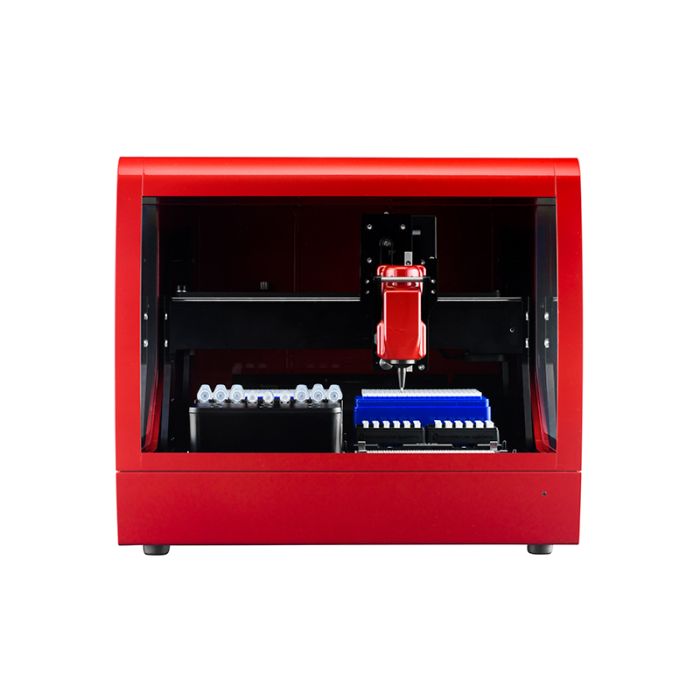
Myra and Myra9 Liquid Handling Systems
Programmable low-volume liquid handling, designed and manufactured by Bio Molecular Systems
Myra is a compact, programmable liquid handling system from Bio Molecular Systems. It automates low-volume pipetting: dispensing, transfers, serial dilution, normalisation, pooling and magnetic bead handling; across genomics, microbiology, drug discovery and proteomics workflows. Camera-guided calibration and pressure-based liquid level sensing support reliable performance at sub-microlitre volumes.
The Myra Liquid Handling System is designed and manufactured by Bio Molecular Systems, an Australian life science instrumentation company. Montreal Biotech is an authorised distributor of Bio Molecular Systems products in Canada.
What is the Myra Liquid Handling System?
The Myra Liquid Handling System is a programmable low-volume liquid handler designed and manufactured by Bio Molecular Systems in Australia. It automates the pipetting steps common to molecular biology, microbiology, drug discovery and proteomics workflows: reagent dispensing, sample transfer, serial dilution, normalisation, pooling, cherry picking and magnetic bead handling.
Low-volume performance. Myra's interchangeable pipette heads cover 1 to 50 µL and are calibrated in accordance with ISO 8655-6:2002. A 50 µL single-channel head and a 50 µL four-channel head are available; each head stores its own calibration data, so heads can be swapped without a technician or recalibration. Positional accuracy is maintained by closed-loop axis control with optical encoders at 100 µm resolution, and deck calibration is performed by an integrated high-precision camera.
Verification during the run. MyraIntelligence® is the verification and adaptation layer. MyraSim® calculates required volumes and checks each step of a protocol before the run begins. MyraVision® scans the deck to confirm consumable type, detect missing plasticware and check that caps have been removed. MyraSense® uses pressure-based liquid level sensing during aspiration and dispensing, allowing detection of low-volume wells and air pockets without conductive tips. Myra Dynamic-Retract® detects a tip sealing against a well base and retracts in small increments so that flow is restored before a suction event can disturb a bead pellet.
Contamination control and footprint. Pipette tips are ejected into an enclosed internal waste container. A HEPA filter rated 99.98% at 0.3 µm and a 70 mW 280 nm UV LED are fitted as standard. Myra occupies a footprint under 2 ft² and weighs 10 kg, which allows operation inside many biological safety cabinets and laminar flow hoods.
Two models. Myra provides six SBS deck positions; Myra9 provides nine, supporting larger plate layouts and multi-plate protocols in a similarly compact instrument.
Key capabilities
Low-volume accuracy
Interchangeable pipette heads dispense from 1 to 50 µL with 5% accuracy at 1 µL and 1% at 50 µL. Heads are calibrated in accordance with ISO 8655-6:2002 and store their own calibration data.
Camera-guided calibration
An integrated high-precision camera calibrates deck positions, removing manual alignment. Only positions in active use are calibrated.
MyraVision® deck verification
The deck is scanned before a run to identify consumables, detect missing plasticware and confirm cap removal, so setup errors are caught before reagents are consumed.
MyraSense® liquid level sensing
Pressure-based sensing monitors aspiration and dispensing in real time. No conductive tips are required, and liquid below the nominal dead volume of a well or tube can be detected.
MyraSim® run planning
Required volumes are calculated and every step is checked for feasibility before the run starts, so a long run does not fail partway for want of reagent.
Myra Dynamic-Retract®
Tip sealing at the base of a well is detected by pressure, and the tip retracts in increments of up to 2 mm until normal flow resumes. This protects magnetic bead pellets during supernatant removal.
Myra Vector-Drive®
Drive technology that reduces the force required for tip pickup, improving seating consistency across channels during multichannel operation and lowering operating noise.
Intelligent mixing
Vortex, advanced and simple mixing strategies are selected according to transfer volume and labware. Vortex mixing homogenises a 5 mL master mix tube in under 30 seconds.
Non-contact dispensing
Liquid is delivered without the tip touching the destination surface, reducing cross-contamination risk and supporting controlled tip reuse within defined steps.
Multi-dispense
A single aspiration is delivered as multiple sequential dispenses, shortening plate filling time while maintaining volumetric consistency.
Foil piercing
Foil-sealed plates, commonly used for NGS index primers and pre-aliquoted reagents, are opened by a controlled multi-step perforation routine rather than a single puncture.
Contamination control
Tips are ejected into an enclosed internal waste container. A HEPA filter (99.98% at 0.3 µm) and a 70 mW 280 nm UV LED are fitted as standard.
Applications overview
Myra is used across four areas. In genomics: qPCR setup, NGS library preparation, library quantification, normalisation and pooling, SPRI bead cleanup and size selection, and nucleic acid extraction. In microbiology: antimicrobial susceptibility testing, including MIC determination by broth microdilution and checkerboard assays, and cell culture media replenishment. In drug discovery: kinase assays, dose-response and serial dilution, compound screening and high-density plate workflows. In proteomics: MALDI-TOF MS sample preparation. The full application library is maintained by the manufacturer on the Bio Molecular Systems applications hub.
Workflows Myra automates
Genomics
Real-time qPCR setup
Myra automates qPCR reaction assembly: master mix preparation and mixing, distribution of master mix across the plate, and transfer of samples and standards into 48-, 96-, 384-well, rotary and other consumable formats. Multi-dispense reduces the number of aspiration cycles required to fill a plate, and intelligent mixing keeps master mix homogeneous before distribution, a common source of Cq scatter when reactions are assembled manually. A 384-well plate can be loaded in under an hour.
Genomics → qPCR reaction setup → uniform low-volume reagent distribution across a full plate → Myra multi-dispense with 5% accuracy at 1 µL
Myra integrates directly with the Mic qPCR Cycler, allowing setup, run and analysis from a single interface, and exports reaction plate layouts to third-party cyclers (see cycler compatibility below).
More detail: Real-Time PCR application page
Genomics
NGS library preparation
Myra automates the liquid handling steps of NGS library preparation: reagent dispensing, enzymatic reaction setup, index and adapter plate handling, and magnetic bead cleanup between steps. The workflow is divided into runs with defined safe stopping points, and off-deck heating is used where the chemistry requires it. Foil piercing allows sealed index primer plates to be opened cleanly without manual handling.
Genomics → NGS library preparation → accurate low-volume enzymatic reaction setup with bead cleanup between steps → Myra 96-well magnetic station, foil piercing and non-contact dispensing
Validated MyraScripts exist for kits from Illumina, Oxford Nanopore, PacBio, NEB, Zymo, seqWell and 10x Genomics.
More detail: NGS Library Prep application page and the Myra Script Library
Genomics
SPRI bead cleanup and size selection
Magnetic bead cleanup determines how much of a library survives to the next step. The step most likely to cause loss is supernatant removal: when a pipette tip seals against the base of a well, pressure builds and, on release, can pull beads out of the pellet. The loss is silent and is usually attributed to protocol variability.
Genomics → SPRI cleanup and size selection → supernatant removal without disturbing the bead pellet → Myra Dynamic-Retract®
Myra Dynamic-Retract® detects the seal by pressure and retracts the tip in increments of up to 2 mm until flow is restored, so the pressure differential never builds to the point of disturbing the pellet. Non-contact dispensing is used for wash and elution buffer addition. Ratio-based double-sided size selection is supported for fragment size windows.
More detail: Bead Cleanup application page
Microbiology
Antimicrobial susceptibility testing
Antimicrobial susceptibility testing by broth microdilution is unforgiving of pipetting error. A single inaccurate transfer propagates down an entire dilution series and can shift an apparent endpoint by one or two doubling dilutions. Across multiple plates and operators, that variability becomes the dominant source of noise in the dataset. Myra automates the dilution and inoculation steps that most affect reproducibility, and normalises pipetting performance across operators, which makes multi-user AST datasets comparable rather than confounded by differences in technique.
Myra's footprint allows operation inside many Class II biological safety cabinets and laminar flow hoods, a practical requirement for work with resistant clinical isolates.
Microbiology → antimicrobial susceptibility testing → reproducible dilution series prepared inside a containment cabinet → compact 10 kg instrument with enclosed tip waste, HEPA filtration and UV LED
Plate layouts and dilution ranges are reconfigured in software, accommodating CLSI M07 and EUCAST broth microdilution methodologies without hardware changes. Checkerboard assays for two-drug interaction studies are generated in a single automated run. Media preparation and post-incubation reading remain off-deck.
More detail: Antimicrobial susceptibility testing application page
Drug discovery
Dose-response and serial dilution
A dose-response curve is only as good as the concentration series underneath it. Errors early in a serial dilution compound through every subsequent point. Myra performs programmable serial dilutions with consistent transfer volumes and mixing at each step, across plate formats and dilution factors defined in software.
Drug discovery → dose-response curve preparation → consistent transfer and mixing at each step so error does not compound down the series → Myra programmable dilution with intelligent mixing
More detail: Serial Dilution MyraScript
Proteomics
MALDI-TOF MS sample preparation
MALDI-TOF MS target plate loading requires small, precisely placed spots. Both volumetric accuracy and positional accuracy matter, because a misplaced or oversized spot affects crystallisation and therefore spectrum quality. Myra automates formic acid addition and matrix deposition onto target plates.
Proteomics → MALDI-TOF MS sample preparation → small, precisely positioned deposits onto a target plate → 20 µL straight-geometry tips with 100 µm positional control
More detail: MALDI-TOF MS formic acid and matrix deposition MyraScript
Works with the cycler you already own
Myra integrates directly with the Mic qPCR Cycler, allowing setup, run and analysis from a single interface without exporting or re-importing sample names. It also exports reaction plate layouts to third-party cyclers, so automation can be added without replacing existing equipment:
| Cycler | Manufacturer | Export |
|---|---|---|
| CFX | Bio-Rad | CFX format file for the CFX Maestro plate editor spreadsheet import, or a CFX LIMS import file carrying sample type, target information and standard concentrations |
| QuantStudio | Thermo Fisher Scientific | QuantStudio plate import file compatible with QuantStudio software v1.5 or v2.6, including sample type, target information and standard concentrations |
| Rotor-Gene Q | Qiagen | SMP format file for import into Rotor-Gene software, available when the reaction plate is a Rotor-Gene Rotor-Disc or tube strips |
Myra and Myra9: which model fits your laboratory?
Both models share the same chassis design, pipette head range, software platform, feature set and warranty. The difference is deck capacity.
| Myra | Myra9 | |
|---|---|---|
| Deck capacity | 6 SBS positions | 9 SBS positions |
| Dimensions (L × W × H) | 460 × 360 × 310 mm | 468 × 520 × 356 mm |
| Weight | 10 kg | 17 kg |
| Pipette heads | Interchangeable; 50 µL single-channel and 50 µL 4-channel | Interchangeable; 50 µL single-channel and 50 µL 4-channel |
| Volume range | 1 to 50 µL | 1 to 50 µL |
| Accuracy / precision | Determined by pipette head (see specifications below) | Determined by pipette head (see specifications below) |
| Contamination control | Enclosed tip waste, HEPA filter, UV LED | Enclosed tip waste, HEPA filter, UV LED |
| MyraIntelligence® | Included | Included |
| Myra Dynamic-Retract® | Yes | Yes |
| Standard warranty | 2 years | 2 years |
| Best suited to | Space-constrained benches, containment cabinets, single-plate and moderate-throughput protocols | Larger plate layouts, multi-plate protocols, higher-throughput runs where deck space is the limiting factor |
Myra9 provides three additional deck positions with the same pipetting performance and a modest increase in footprint and weight.
Specifications
Accuracy and precision are properties of the pipette head, not of the instrument body, and are reported as two separate figures. They are identical on Myra and Myra9.
50 µL single-channel head
| Volume | Accuracy | Precision |
|---|---|---|
| 1 µL | 5% | ≤ 10% CV |
| 5 µL | 1% | 1% CV |
| 50 µL | 1% | 0.5% CV |
50 µL four-channel head
| Volume | Accuracy | Precision |
|---|---|---|
| 1 µL | 5% | ≤ 10% CV |
| 5 µL | 2.5% | 1% CV |
| 50 µL | 1% | 0.5% CV |
Both heads: 1 to 50 µL volume range; calibrated in accordance with ISO 8655-6:2002.
Instrument specifications (Myra and Myra9)
| Attribute | Specification |
|---|---|
| Position control | Closed loop, 100 µm resolution, optical encoders |
| Calibration | High-precision integrated camera |
| Tip disposal | Enclosed internal waste container |
| HEPA filter | 99.98% at 0.3 µm |
| UV lamp | 70 mW, 280 nm UV LED |
| Communication | USB 2.0 |
| PC requirements | Windows 11 (64-bit), Intel i5 or equivalent, 8 GB RAM, 3 GB disk, 1080p display |
| Operating temperature | 18 to 30 °C |
| Operating humidity | 20 to 80% |
| Electrical | 100 to 240 VAC, 50/60 Hz, 1.4 A |
| Pipette tips | 384-well racks of 50 µL filtered tips; optional 20 µL straight-geometry tips for 1536-well work |
| Standard warranty | 2 years from invoice date; extendable by 1, 2 or 3 years if taken within 90 days |
| Regulatory status | Research use only |
Indicative run times
| Task | Time* |
|---|---|
| 5 µL transfer into 96 wells | 4 minutes |
| Dispense across 384 wells | 6 minutes |
| qPCR setup, 96 samples | 18 minutes |
| 384-well plate load | Under 1 hour |
| ONT Rapid Barcoding library prep | Under 1 hour |
| Illumina DNA Prep library prep | Approximately 2 hours |
*Timing depends on protocol, labware and pipette head configuration.
Frequently asked questions
Which liquid handling robots use AI?
Bio Molecular Systems' Myra uses MyraIntelligence®, a verification layer built from three components. MyraSim® calculates the volumes a protocol needs and checks every step is achievable before the run begins. MyraVision® uses computer vision to scan the deck and confirm that consumables are present, of the right type and uncapped. MyraSense® uses pressure-based sensing to monitor liquid levels during aspiration and dispensing, without conductive tips. Together they check the run before it starts and adapt during it.
Can an automated liquid handler work with a qPCR cycler I already own?
Yes. Myra exports reaction plate layouts to the Bio-Rad CFX (CFX or CFX LIMS import file), the Thermo Fisher QuantStudio (plate import file for software v1.5 or v2.6) and the Qiagen Rotor-Gene Q (SMP file), each carrying sample type, target information and standard concentrations. It also integrates directly with the Mic qPCR Cycler from Bio Molecular Systems, sharing one interface for setup, run and analysis. Adding automation does not require replacing an existing cycler.
What size liquid handler fits inside a biological safety cabinet?
Myra weighs 10 kg and occupies under 2 ft² of bench space, which allows it to operate inside many Class II biological safety cabinets and laminar flow hoods. That matters for work with clinical isolates or other material where containment is not optional, and it is the main practical constraint that rules out larger robotic platforms.
Is there an automated option for MIC and antimicrobial susceptibility testing?
Yes. Myra automates two-fold serial dilution of antimicrobial compounds across 96-well plates and dispenses bacterial inoculum consistently across all wells, which is where most of the operator-to-operator variability in broth microdilution originates. Plate layouts and dilution ranges are reconfigured in software, accommodating CLSI M07 and EUCAST methodologies. Checkerboard assays for two-drug interaction studies are generated in a single run. Media preparation and post-incubation reading remain manual.
What is the Myra Liquid Handling System?
Myra is a programmable low-volume liquid handling system manufactured by Bio Molecular Systems. It automates pipetting tasks: dispensing, transfers, serial dilution, normalisation, pooling and magnetic bead handling, across molecular biology, microbiology, drug discovery and proteomics workflows.
What applications can Myra automate?
Myra is used across four areas. In genomics: qPCR setup, NGS library preparation, library quantification, normalisation and pooling, SPRI bead cleanup and size selection, and nucleic acid extraction. In microbiology: antimicrobial susceptibility testing, including MIC determination by broth microdilution and checkerboard assays, and cell culture media replenishment. In drug discovery: kinase assays, dose-response and serial dilution, compound screening and high-density plate workflows. In proteomics: MALDI-TOF MS sample preparation.
What volume range does Myra handle?
Myra's interchangeable pipette heads operate from 1 to 50 µL, with 5% accuracy at 1 µL and 1% at 50 µL. Heads are calibrated in accordance with ISO 8655-6:2002.
What is the difference between Myra and Myra9?
Myra9 provides nine SBS deck positions to Myra's six, supporting larger plate layouts and multi-plate protocols. Pipetting performance, pipette head options and features are the same on both.
Can Myra handle 384- and 1536-well plates?
Yes. Closed-loop axis control with optical encoders maintains tip position at 100 µm resolution, and optional 20 µL straight-geometry tips improve clearance in 1536-well formats. A 384-well plate can be loaded in under an hour.
Is Myra suitable for a small laboratory?
Myra weighs 10 kg and occupies under 2 ft² of bench space, which allows it to operate inside many biological safety cabinets and laminar flow hoods. It is designed for laboratories where a full-scale robotic platform is not practical.
Does Myra require specialist installation or maintenance?
No technician installation is required. Pipette heads store their own calibration data and can be exchanged by the user without recalibration.
How is Myra programmed?
Standard workflows are configured through Workbench 2.0. More complex protocols use MyraScript™, a Python-based scripting layer. Validated scripts for a range of commercial kits are published in the public Myra Script Library.
What warranty does Myra come with?
Both Myra and Myra9 carry a two-year standard warranty from the date of invoice, extendable by one, two or three years if taken out within 90 days. Warranty claims are handled through your regional distributor.
Can Myra be used for clinical diagnostics?
Myra is a research instrument. It is not approved or certified for in vitro diagnostic use. Laboratories requiring an IVD-certified real-time PCR platform should refer to the Mic-IVD Cycler.
Resources
- Myra e-brochure
- Myra9 e-brochure
- Myra Script Library: validated scripts for commercial kits
- Myra warranty policy
- Product overview and capability video (YouTube)
Myra and Myra9 are designed and manufactured by Bio Molecular Systems. Learn more about the Myra Liquid Handling System from Bio Molecular Systems
| Detecteur | Photomultiplicateur à canaux hautement sensible (CPM) - rapport signal/bruit optimal grâce à une réduction efficace du bruit (technologie de réduction du rapport signal/bruit). |
|---|---|
| Dimensions | 31x35x46 cm |
| Poids net | 9.0 / 19.8 (kg/lbs) |
| Source de courant | 100 ― 120 VCA, 50/60 Hz, nominal (plage de fonctionnement 90 ― 130 VCA) 200 ― 240 VCA, 50/60 Hz, nominal (plage de fonctionnement 180 ― 256 VCA) |
| Catalog Number | Nom du produit | Prix | Qté |
|---|---|---|---|
| MIC-TUBES-BOX | 1 Box: 20 racks of 48 tubes / rack, 960 tubes in strips of 4 with matching caps | 265,00 $CA | |
| MIC-TUBES-CASE | MIC Tubes and Cap 12 boxes of (20 racks of 48 tubes / rack, 960 tubes in strips of 4 with matching caps) | 2 495,00 $CA | |
| MYRA-TIPS384-50P | Myra 384 Well Tips (10 racks, 3840 tips per box) | 997,14 $CA | Out of stock |
| MYRA-TIPS384-50-CARTON | Myra 384 Well Tips (5 boxes = 50 racks, 19,200 tips per case) | Out of stock | |
| Myra-LB96 | MYRA 96 Well Loading Block | 754,17 $CA | Out of stock |
| MYRA-LBMP | Myra Multipurpose Loading Block | 1 515,00 $CA | Out of stock |
| MYRA-LBMIC | Myra Loading Block for Mic Racks | 531,67 $CA | Out of stock |