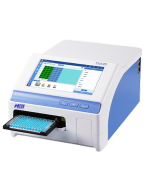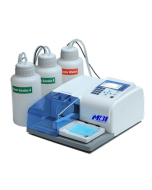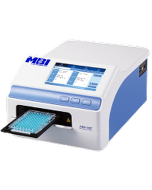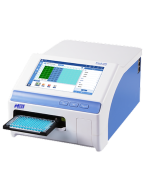
MBI Evolution Microplate Reader (340-750nm)
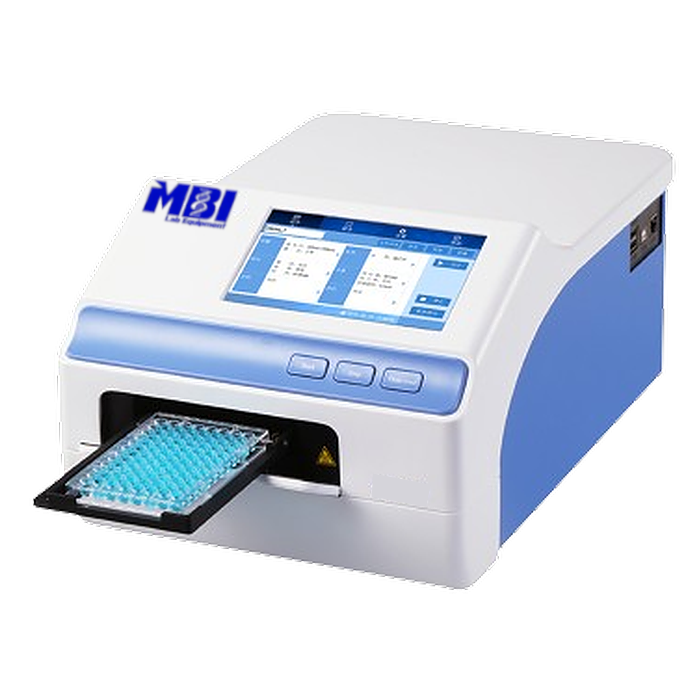
Why Choose the MBI Evolution Microplate Reader?
When your lab needs a reliable 96-well plate reader, the MBI Evolution delivers precision, speed, and flexibility. This standalone microplate reader reads a full 96-well plate in under 6 seconds, making it one of the most efficient absorbance microplate readers in its class.
Unlike complex multi-mode systems, the MBI Evolution focuses on what most researchers need: fast, accurate absorbance detection across the UV-Vis spectrum. With four standard filters pre-installed (405, 450, 492, and 630 nm) and 26 additional filter options available, you can customize the system for virtually any colorimetric or ELISA protocol.
Key Features of the MBI Evolution Absorbance Plate Reader
- Broad Wavelength Range: 340–750 nm coverage for UV-Vis absorbance applications
- 8-Position Filter Wheel: Switch between wavelengths automatically — no manual filter changes
- 7-Inch Touchscreen: 800×480 pixel display with optional mouse support for easy programming
- Dual Measurement Mode: Use up to two filters per plate for calculated comparisons and kinetic studies
- Dynamic Shaking: Three programmable speeds (3.5 Hz, 4.7 Hz, 7.0 Hz) for optimal sample mixing
- Standalone Operation: Onboard software with curve fitting and real-time results — no PC required
- Visual Plate Layout: Graphical 96-well interface for labeling standards, samples, blanks, and controls
- Large Storage: Save 200 programs and 100,000 test records internally
- Flexible Connectivity: USB ports for PC, printer, mouse, and flash drive export
Ideal Applications
The MBI Evolution ELISA plate reader is trusted by researchers for:
- ELISA and immunoassays
- Protein and nucleic acid quantification
- Enzyme activity and kinetic studies
- Cell viability and cytotoxicity assays
- Endpoint and kinetic absorbance measurements
Technical Specifications
| Wavelength Range | 340–750 nm |
| Standard Filters | 405, 450, 492, 630 nm |
| Filter Capacity | 8-position integrated wheel |
| Half-Bandwidth | 3–9 nm |
| Readout Range | 0–4.000 Abs |
| Linearity (405 nm) | 0–2.000 Abs ±1%; 2–4.000 Abs ±2% |
| Precision | CV ≤0.2% (0–3 Abs); CV ≤1.0% (3–4 Abs) |
| Test Speed | <6 seconds per 96-well plate |
| Incubation (MR9600-T) | Ambient +5°C to 50°C |
| Shaking Modes | Slow (3.5 Hz), Medium (4.7 Hz), Fast (7.0 Hz) |
| Display | 7-inch touchscreen, 800 × 480 px, mouse compatible |
| Storage | 200 programs, 100,000 test records |
| Connectivity | USB (PC, printer, mouse, flash drive) |
| Dimensions (W × D × H) | 29.5 × 44.0 × 22.5 cm / 11.6 × 17 × 8.75 in |
| Weight | 10 kg |
| Light Source | Quartz-halogen lamp, 6V / 10W |
| Detector | Highly sensitive channel photomultiplier (CPM) |
| Microplate Formats | 96-well (flat, round, and V-bottom) |
What's Included
- MBI Evolution Microplate Reader main unit
- 4 pre-installed filters (405, 450, 492, 630 nm)
- Power cable and user manual
Order Your MBI Evolution Microplate Reader Today
The MBI Evolution is in stock and ready to ship. Add this reliable absorbance microplate reader to your lab and streamline your ELISA, protein, and kinetic workflows. Contact Montreal Biotech for filter accessories, extended warranties, and volume pricing.
SKU: MBIZR-05959-99-2
______________________________________________________________________________________________
Frequently Asked Questions
What is the wavelength range of the MBI Evolution Microplate Reader?
The MBI Evolution covers a 340–750 nm spectral range, making it suitable for a wide variety of colorimetric, UV-Vis, and ELISA applications.
Is the MBI Evolution an ELISA-compatible plate reader?
Yes. The MBI Evolution is an ideal ELISA microplate reader, with pre-installed filters at 405, 450, 492, and 630 nm — the most common wavelengths for ELISA assays.
How fast is the MBI Evolution Microplate Reader?
It reads a full 96-well plate in under 6 seconds, with high precision (CV ≤0.2% from 0–3 Abs).
Does the MBI Evolution require a computer?
No. This standalone microplate reader includes onboard software, a 7-inch touchscreen, and internal storage for 200 programs and 100,000 test records.
records.
| Source lumineuse | Lampe quartz-halogène |
|---|---|
| Plage de mesure | 0.000…4.000 OD |
| Précision | CV ≤ 0,2 % (0-3 Abs) ; CV ≤ 1,0 % (3-4 Abs) à 405 nm. |
| Précision | ±1 % (0-3Abs) ±2 % (3-4Abs) à 405nm |
| Filtres standards | 405, 450, 492, 630 nm |
| Sélection de la longueur d'onde | Filtres |
| La moitié de la largeur de bande des filtres | 3~9nm |
| Plage de longueur d'onde | 340 - 750nm |
| Vitesse de Test | 6 s pour une plaque de 96 puits. |
| Detecteur | Photomultiplicateur à canaux hautement sensible (CPM) - rapport signal/bruit optimal grâce à une réduction efficace du bruit (technologie de réduction du rapport signal/bruit). |
| Agitation | 3 modes de secouage : lent, moyen et rapide. |
| Système optique | Filtres |
| Linéarité (±) | <±0,25 % et ±0,0025 OD de 0,1 OD à 2,5 OD à 492 nm |
| Connectivité | 3 ports USB, pour PC, imprimante et disque USB |
| Dimensions | 440 x 295 x 225 mm |
| Poids net | 10.0 Kg |
| Opération PC | Oui |
| Formats des microplaques | Plaque de 96 puits (formats de puits plats, ronds et en V). |