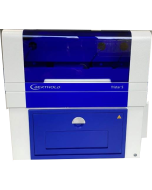
Tristar 3 Multimode Reader
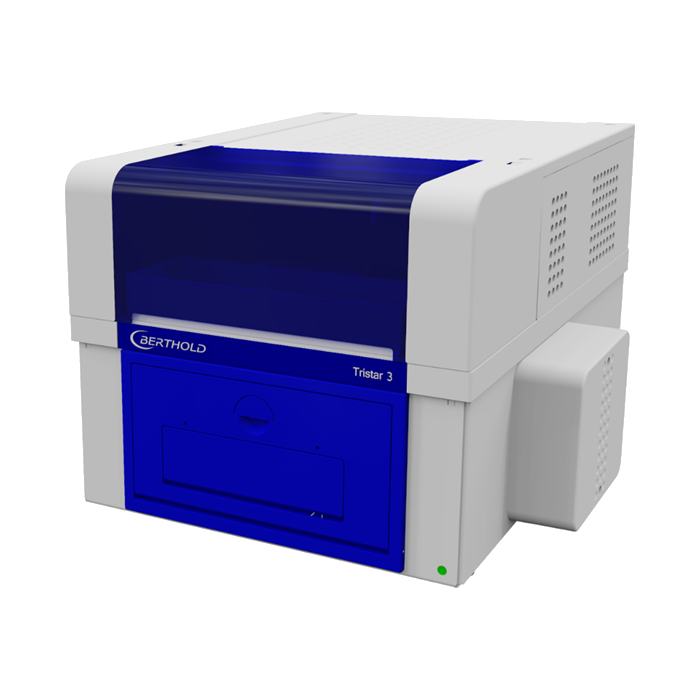
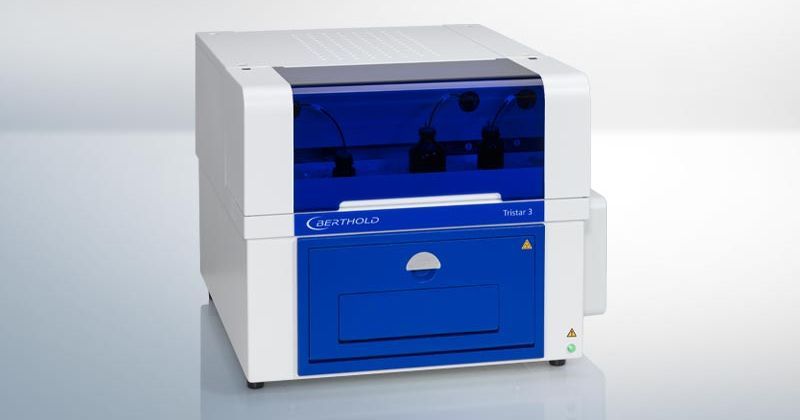
The TriStar 3 is a user-friendly and affordable filter-based multimode plate reader that offers high-performance luminescence, fluorescence and absorbance analysis. Equipped with ONE-4-ALL optics for uncompromised performance across all detection modes, the system is ready to perform absorbance, luminescence and fluorescence measurements with the flexibility to master changing plate reading applications.
The quick-change filter technology provides up to 40 different excitation and emission filters mounted on exchangeable filter slides. Filters deliver high transmittance properties and can be up to 25-fold more sensitive than monochromators. The broad wavelength range covers UV through the visible and into the far red / NIR in selected configurations.
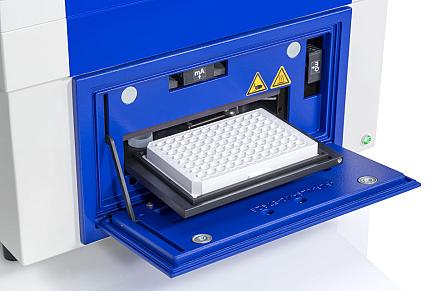
The ergonomic design provides full frontal access for plate loading, filter change and reagent connection. An integrated front compartment stores reagent vials, and a removable trough can be filled with water or ice to keep temperature-sensitive reagents cooled. The flat top surface provides space for a laptop.
- ONE-4-ALL optics for uncompromised performance in all detection modes
- High-sensitivity luminescence detection with true photon counting
- Absorbance (UV/VIS) with photodiode detection
- Fluorescence intensity (top reading) including FRET
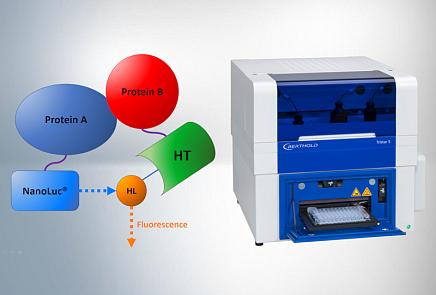
- BRET / BRET2 and NanoBRET upgradeable with dedicated filter sets
- High-performance filter system — up to 40 excitation and emission filters on exchangeable slides
- Crosstalk reduction design — crosstalk as low as 10⁻⁶ (black plates)
- Optional JET injectors (up to 3) with variable volumes 10–100 µL in pre-measurement or measurement position
- JET injector accuracy greater than 98 % over the entire volume range
- Ultra-fast injection speed eliminates delay between injection and measurement — ideal for flash luminescence
- Negligible shear forces for cell-friendly injection (e.g. Aequorin-based calcium assays)
- Optional temperature control from +5 °C above ambient up to 45 °C
- Three shaking modes (linear, orbital, double-orbital) with variable amplitude and speed
- LightCompass software available in Basic, Plus and Professional versions
- 21 CFR Part 11 compliance supported
- Reporter gene assays
- Cell viability and cytotoxicity
- ATP detection and cell proliferation
- Protein-protein interaction (BRET, NanoBRET)
- FRET-based assays
- ELISA and colorimetric assays
- DNA/RNA quantification (UV absorbance)
- Time-resolved fluorescence (TRF) and TR-FRET / HTRF
- Flash and glow luminescence kinetics
- Calcium mobilisation and GPCR screening
- AlphaScreen (with laser diode option)
| Specification | Value |
|---|---|
| Measurement Technologies | Luminescence, BRET, BRET2, Fluorescence (top), FRET, Absorbance (VIS & UV), Time-Resolved Fluorescence, TR-FRET / HTRF |
| Optical System | ONE-4-ALL filter-based optics |
| Excitation Source | Xenon flash lamp, 10 W, 200 – 1000 nm |
| Detector | Low-noise photomultiplier tube (dual mode), 280 – 650 nm; Photodiode, 200 – 1000 nm |
| Filter Capacity | Up to 40 excitation and emission filters on exchangeable slides |
| Luminescence Sensitivity | ATP: < 6 amol/well (96-well plate) |
| Fluorescence Sensitivity | FITC: < 7 amol/well (384-well plate) |
| Absorbance Accuracy | Better than 2 % (96-well) |
| Absorbance Precision | Better than 0.6 % CV (96-well) |
| Dynamic Range | 6 orders of magnitude (PMT); 0 – 3.5 OD (photodiode) |
| Crosstalk | 10⁻⁶ (black plates) |
| Plate Formats | 6 to 384 well (solid and strip), 128 × 86 mm, height 14.0 – 21.0 mm; Petri dishes 35 / 60 mm; Eppendorf μPlate G 0.5; Standard cuvettes (with cap) |
| Injectors (Optional) | Up to 3 JET injectors; Volume 10 – 100 µL; Speed 200 – 440 µL/sec; Accuracy > 98 %; Precision > 98 % |
| Temperature Control (Optional) | +5 °C above ambient to 45 °C |
| Shaking | 3 modes (linear, orbital, double-orbital), variable amplitude and speed |
| Operation Modes | Endpoint, kinetic (up to 7 days), repeated, plate repeat (up to 50,000), scanning (up to 10,000 points), spectral scanning, dispensing, shaking, delay (up to 600 s) |
| Integration Time | 0.05 – 600 seconds |
| Interface | USB |
| Operating System | Windows 7 / Windows 10 (32/64 bit) |
| PC Requirements | Pentium-like CPU 2 GHz or better, 1 free USB 2.0 port |
| Dimensions (W × D × H) | 391 × 470 × 344 mm |
| Weight | Approx. 20 kg |
| Operating Voltage | 24 VDC ± 5 % |
| Max. Power Consumption | 140 VA |
| Certifications | CE, NRTL (USA/CAN) |
| Ambient Temperature | Operation: 15 °C – 35 °C; Storage: 0 °C – 40 °C |
| Humidity | 10 – 80 %, non-condensing |
| Altitude | Max. 2000 m above sea level |
Product images are representative. Specifications subject to change.
To learn more please visit Lumat LB 9510 Tube Luminometer.
| Wavelength Selection | High quality interference filters |
|---|---|
| Measurement Technologies | Luminescence BRET, BRET² Fluorescence (top) Absorbance UV & VIS TR |
| Luminescence | 6 amol/well ATP (96 well) |
| Fluorescence | < 7 amol/well FITC (384sv) |
| Absorbance Range | Accuracy better 2% Precision better 0.6% |
| Time-Resolved Fluor. | < 35 amol/well |
| Dynamic range (linearity) | 6 orders of magnitude (photon counter) 0-3.5 OD (photodiode) |
| Crosstalk | 5 x 10⁻⁶ |
| Injection unit | up to 3 injectors, JET injection technology variable volumes: 10 – 100 μL speed 200 – 440 μL/sec accuracy better 2% (over entire range of volume) precision better 2% (over entire range of volume) injections into microplates with up to 384 wells |
| Shaking | 3 modes, variable amplitude and speed |
| Microplate Formats | 6 to 384 well, solid and strip, Dimensions 128 x 86 mm (L x W) height 14.0 – 21.0 mm (adapters necessary) Petri dishes 35 and 60 mm Eppendorf μPlate G 0.5 Standard cuvettes (with cap) |
| Interface | USB |
| PC operating system | Windows 7 (32/64 bit), Windows 10 (32/64 bit) |
| PC Requirements | Pentium like CPU (2 GHz or better / Intel Core iX recommended), 1 free USB port |
| Regulations | CE, NRTL |
| Power Supply | 100 – 240 VAC ±10% 50 / 60 Hz Class I |
| Voltage | 24 VDC ± 5% |
| Dimensions | 391 x 470 x 344 mm |
| Detector | Low-noise photomultiplier tube in dual mode, spectral range 280 - 650 nm (up to 850 nm with extended range PMT) Photo diode: spectral range 200 – 1000 nm |
| Light Source | Xenon flash lamp |
| Wavelength range | 200 - 1000nm |