Zoom HT LB 920 Plate Coating System
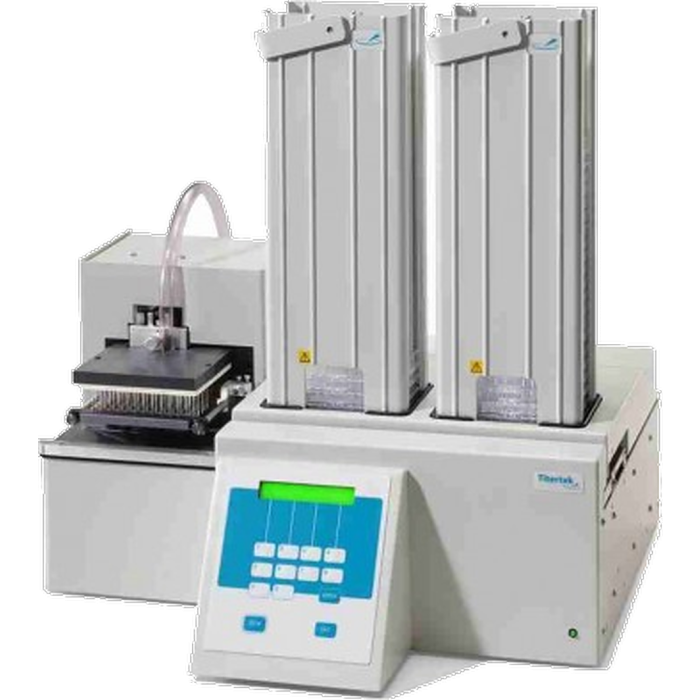
Zoom HT LB 920 Plate Coating System
High-Throughput Microplate Washer & Dispenser with Built-In Stacker
Overview
The Zoom HT LB 920 is a robust, easy-to-use microplate washer and dispenser engineered for speed and throughput. Developed by Berthold Technologies, it is the ideal system for ELISA coating workflows, combining rapid wash cycles with precise reagent dispensing in a compact, benchtop footprint.
Unique in its class, the Zoom HT features a built-in microplate stacker that seamlessly shuttles plates between storage, wash, and dispense positions on a single rail. An optional Dispense Module adds syringe-based reagent delivery with minimal dead volume, enabling walk-away plate coating and manufacturing workflows that produce ready-to-use plates.
Applications
The Zoom HT LB 920 is designed for laboratories requiring high-throughput microplate processing across a range of applications:
Key Features
- 96-channel wash head for fastest processing of 96-well and 384-well microplates
- Built-in microplate stacker with single-rail design for seamless plate transfer
- Typical throughput of 190 washed plates per hour (up to 1,330 plates per day)
- Triple wash of a 96-well plate in just 14.5 seconds (17 seconds including stacking)
- Residual volume <1 µL/well for excellent assay reproducibility
- Regular and Superwash modes for flexible wash intensity
- 3D-positioned aspirate needles with adjustable descent speeds (slow, medium, fast)
- Circular aspiration function for ultra-low residual volumes
- Self-emptying liquid discharge system for uninterrupted batch processing
- Continuous antifoam addition to waste trap for handling problematic reagents
- Liquid level sensors for reagent and waste monitoring
- Administrator mode to protect protocols from unauthorized changes
- Shaking function: up to 80 seconds, 1 mm amplitude, 12 Hz frequency
- Soak time programmable from 0 to 99 seconds
Optional Dispense Module
The optional Dispense Module transforms the Zoom HT Washer into a fully integrated washer-dispenser combination system. Berthold's proprietary syringe-based liquid delivery system ensures timely and accurate one- or two-channel reagent dispensing with minimal dead volume — critical for preserving precious antibody conjugates and coating reagents.
- Positive displacement syringe technology for accurate reagent delivery
- 2× 10 mL syringes with separate channels
- 8-way and 16-way dispense manifolds for 96- and 384-well plates
- Dispense volume: 5 – 300 µL
- Dispense accuracy: <1% typical at 100 µL
- Dispense precision: CV ≤1% at 200 µL
- Minimal dead volume conserves expensive reagents
Wash Performance
The Zoom HT is engineered to deliver exceptional wash performance with minimal residual volume. Flexible 3D positioning of aspirate needles combined with a reliable vacuum system and a circular aspiration function achieves residual volumes below 1 µL per well. This low carryover improves assay reproducibility and reduces the number of wash cycles required.
The system accommodates both 96-well plates (including strips) and 384-well plates conforming to ANSI SLAS dimensions. Rapid positioning of the wash head provides 384-well wash speeds comparable to dedicated 384-channel washers.
Programming & Control
The Zoom HT stores up to 50 user-defined programs, each supporting 1 to 99 wash cycles. Wash fluid selection is available across 4 inlets, allowing automated switching between buffers, water, and cleaning solutions. Soak times, shaking parameters, and aspirate tip descent speeds are fully programmable per program step.
An administrator mode locks protocols to prevent unauthorized modifications, ensuring GLP compliance and consistent performance in multi-user environments.
Technical Specifications
| Wash System | |
| Wash Head | 96-channel wash head for 96-well and 384-well microplates |
| Microplate Formats | 96-well plates and strips, 384-well; ANSI SLAS dimensions |
| Stacker | Built-in single-rail design connecting wash, dispense, and storage positions on one level |
| Residual Volume | < 1 µL/well |
| Wash Modes | Regular, Superwash |
| Aspirate Tip Descent Speeds | Slow, Medium, Fast |
| Shaking | Up to 80 s, amplitude 1 mm, frequency 12 Hz |
| Soak Time | 0 – 99 s |
| Number of Programs | 1 – 50 |
| Wash Cycles per Program | 1 – 99 |
| Wash Fluid Inlets | 4 inlets |
| Protocol Protection | Administrator mode to prevent unauthorized changes |
| Processing Speed | |
| 96-Well Plate, 3 Cycles, Point Aspiration | 14.5 s |
| 96-Well Plate, 3 Cycles, incl. Stack | 17 s |
| 96-Well Plate, 3 Cycles, Crosswise Aspiration, incl. Stack | 18.5 s |
| Typical Throughput | 190 plates/hour; up to 1,330 plates/day |
| Dispense Module (Optional) | |
| Dispense Manifolds | 8-way and 16-way |
| Manifold Ports | 2 in direct proximity to wash head |
| Syringe Size | 2 × 10 mL, separate channels |
| Dispensing Technology | Positive displacement |
| Number of Reagents | Up to 2 |
| Dispense Volume | 5 – 300 µL |
| Dispense Accuracy | < 1% typical at 100 µL |
| Dispense Precision | CV ≤ 1% at 200 µL |
| System Requirements | |
| Liquid Path Materials | Stainless steel, Teflon®, PVC, Norprene, Silicone, Polysulfone |
| Operating Voltage | 24 VDC ± 5% |
| Max. Current Consumption | 3.0 A |
| Power Supply | Desktop power supply; Input: 100–240 VAC ±10%, 50/60 Hz; Output: 24 VDC / 3.75 A |
| Protection Class | III (instrument); I (power supply) |
| Certifications | CE, UKCA |
| Temperature Range | Storage: 0° to 40°C; Operation: 15° to 35°C; Transport: –20° to 50°C |
| Humidity | 10 – 80%, non-condensing (up to 31°C); decreasing linearly to 50% at 40°C |
| Altitude | Max. 2000 m above sea level |
| Pollution Degree | 2 |
| Physical Specifications | |
| Dimensions — Washer (W × D × H) | 589 × 420 × 645 mm |
| Weight — Washer | 26.3 kg |
| Dimensions — Dispense Module (W × D × H) | 168 × 405 × 226 mm |
| Weight — Dispense Module | 8.5 kg |
| Wash Head | 96 channel wash head for fastest processing of 96 and 384 well microplates |
|---|---|
| Microplate Formats | 96 well plates and strips, 384 well; Dimensions according to ANSI SLAS |
| stacker | One-rail design connecting wash, dispense, and storage positions in short distance on one level |
| Shaking | Up to 80 s, amplitude 1mm, frequency 12 Hz |
| Soak Time | 0–99 s |
| Wash mode | Regular and Superwash |
| Number of programs | 1–99 |
| Wash cycles per program | 1-99 |
| Wash Fluid Selection | 1 inlet (standard), 2 or 4 inlet versions |
| Protocol Protection | Admin mode to prevent unauthorized changes |
| Residual volume | < 2 μl/well |
| Plate Processing Speed | 96 well plate, 1 cycle 300 μl incl. stack: 14 s 96 well plate, 3 cycles 300 μl incl. stack: 24 s 384 well plate, 3 cycles 75 μl incl. stack: 44 s |
| Power requirements | 29.5 kg / 65 lb |
| power consumption [W] | 300 VA |
| Operating Temperature | +10°C – +40° C |
| Liquid Path Materials | Stainless steel, Teflon®, PVC, Norprene, Silicone, Polysulfone |
| Dispense Manifolds | 8-way and 16-way manifolds available |
| Dispense Manifold Ports | 2 in direct proximity to wash head for immediate dispensing after aspiration |
| Syringe Size | 2 x 10ml, separate channels |
| Dispensing Technology | Positive Displacement |
| Dispense Speed | 1-8 |
| Number of Reagents | Up to 2 |
| Dispensing Volume | 5 to 300μl |
| Dispensing inaccuracy | ±2% at 50 to 300 μL |
| Dispensing precision | ≤ 2.5% CV at 200 μl |